

In my time as a Sales Engineer there were certain questions and products that were brought up over and over. There were of course niche things, but I often found myself answering the same questions or recommending the same solutions multiple times. Things like Audio Mixers, Mics, and one of my favorite’s – “Audio Video Extenders”
If you’re reading this, I assume you know what Audio Video (AV) Extenders are (feel free to skip this paragraph if you do). But in the slim chance you don’t, I will explain. They basically take baseband signal (HDMI, DisplayPort, SDI etc.) and extend their reach by converting the signal to be sent over something like Fiber Optic or CAT6 cables. This allows for way more flexibility as most products are made with a single cable like HDMI in mind and that has severe limitations. For a more in-depth explanation check out Eaton’s very well made article here.

Now you may be wondering. Why were AV Extenders brought up so often and why are they so important?
Why Audio Video Extenders Are Needed
I already started to go into it a little with my explanation of what AV Extenders are, but these devices are a backbone in AV and Broadcast deployments. When I was an AV installer, we used extenders on almost every project. The minute you realize you need to go a long distance, and you only have a 6 or 10 foot HDMI cable, reality hits. You need to move signals across rooms, down halls, up into a rack that is two floors away, or through an arena where the only thing longer than the cable run is the list of people that need the feed.
Baseband formats are great at what they do, but they are not built for long distances. Extenders solve the distance problem, and they also solve some very real installation problems. CAT is easy to install, and you can run it where HDMI simply will not go. With AV Extenders you can power devices over the same run in some cases and they usually come with additional features that are nice to have.
Reliability is the other big reason. A proper extender kit gives you a known path and known maximum distance. If a source is not showing up on a display 300 feet away, you now have a clear chain to troubleshoot. That beats guessing which passive coupler or sketchy long HDMI cable decided to retire in the ceiling.
Common Use Cases
There are a lot of places extenders fit.
- Conference and training rooms. You want a laptop at the table and a projector at the back of the room, with USB for a camera and a touch screen returning control to the host PC. You are not doing that with a single HDMI cable
- Houses of worship and campuses. Overflow rooms, signage, confidence monitors, audio to the lobby, video to the cry room. Long runs and split feeds are standard.
- Arenas and large venues. Production happens in one place, viewers and operators are spread everywhere. Fiber or CAT runs with extenders keep latency tight and cabling sane.
- Production flypacks. Keep cameras or stage boxes far from the switcher, but still feed tally, return, or audio where you need it.
- Broadcast facilities. This is the funny one. Extenders get overlooked in broadcast because there is a lot of SDI and now a lot of IP. The reality is, you still need point to point connectivity for operator stations, multiviews on the wall, or that one legacy device that refuses to die. Extenders are the glue that makes dissimilar gear live together without drama.
Meet Eaton (Tripp Lite)

Eaton (Tripp Lite) has been in this space for a long time with a deep catalog of AV and IT gear. Their lineup covers AV Extenders (of course), cables, racks, UPS’, KVM’s, and more. They also offer TAA compliant models, which matter if you sell into government or education with grant funding, or any project where compliance is not a suggestion. Eaton even maintains a clear TAA overview for buyers so you can check the box with confidence.
When it comes to audio and video extenders, Eaton has one of the most complete selections out there. Whether you’re running HDMI over CAT for a conference room display, extending 4K video across a large facility, or just keeping a control surface connected from a safe distance, they’ve got something that fits. Their extender kits handle long cable runs without the signal dropouts or handshake issues that cheaper options struggle with. Most are built with installers in mind with compact housings, PoE power, and simple plug-and-play operation that keeps projects moving instead of troubleshooting.
Sometimes you do not want to extend video at all, you only want to move audio. Maybe you are feeding distributed audio in a building, tying an analog mixer into a Dante network, or getting program audio in and out of a USB computer without more I-O boxes. Eaton has new Dante pieces that make this part simple:
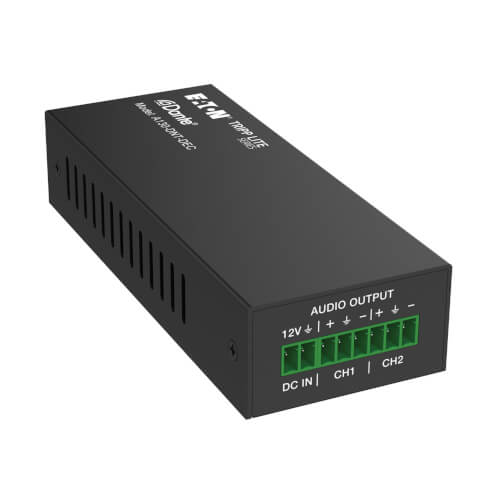
A130-DNT-DEC – Dante 2-Channel Analog Audio Decoder
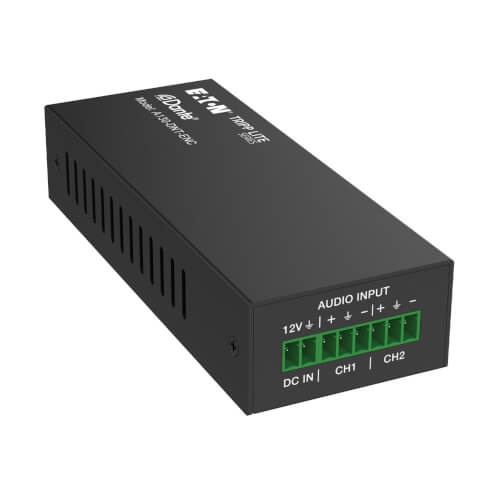
A130-DNT-ENC – Dante 2-Channel Analog Audio Encoder
- Analog audio output supports balanced or unbalanced audio output
- Audio output supports 3-level gain adjustment: +18dBu, 0dBu (default) and -10dBV
- Audio sampling rate supports 44.1 kHz, 48 kHz and 96 kHz (24-bit)
- Dante solution supports AES67 RTP audio transmission
- Can be powered using a PoE network switch or a DC 12V power supply (not included)

A130-DNT-USB – Dante 2-Channel USB Audio Encoder/Decoder
- Complies with USB 2.0 full-speed operation and Audio Device Class V1.0
- Analog sound card supports MIC input and SPK output
- Audio sampling rate supports 44.1 kHz, 48 kHz and 96 kHz (24-bit)
- Dante solution supports AES67 RTP audio transmission
- Can be powered using a PoE network switch or a DC 12V power supply (not included)
I like these because sometimes you just want to move audio around. Audio can also have a lot of variables that these account for, like gain levels, signal types, and power needs. Having balanced and unbalanced I/O options, PoE for clean installs, and simple hardware controls makes life a lot easier. You don’t have to fight through a software menu just to pass signal.
What Next?
Audio Video Extenders get brought up so much because the distance problem with infrastructure is not going away. Rooms get bigger, racks get farther, and projects rarely match the perfect diagram in our heads. Extenders make the messy parts manageable, and when you pick reliable gear, you stop thinking about the link and focus on the show.
If you need help sorting through extender options, the JB&A and Eaton team will work together to find what fits your needs. Whether it’s a simple point-to-point HDMI run, a full Dante audio setup, or a mix of both in a larger system, we can help design a solution that’s reliable, compliant, and makes sense to install. Just tell us what you’re trying to connect, and we’ll take it from there. Contact [email protected] to get started.

